Monday, 16 December 2013

Uruguay Part 3

Uruguay Part 3

Colonia del Sacramento

Sunday 8th December, 2013 we left here early to drive 4 1/2 hours to Colonia del Sacramento, or in our case somewhat longer, after getting lost in Montevideo for a while.  Had we travelled further around the port the first time we were in the city we would have realised that was the most direct route.  Maps here are somewhat deceiving and no one way streets are marked.  

Once on the highway out of Montevideo, it is a pretty straightforward journey.  Entering Colonia del Sacramento is very impressive as the main road is lined with huge palm trees either side.  Amazingly we found our hotel right away even though it was tucked down a little old street with no sign depicting that there was even a hotel there.  

Colonia del Sacramento is a Medieval walled city, centred around the old port, now the yacht club.  The new town is an extension of the old but although quite separate merges quite seamlessly.  However even the new town is old.  Not knowing what the hotels would be like in such an old place, with mostly street parking only, we elected to stay at the Radisson.  We thought it might be a little out of place until we arrived and found that it was for the most part hidden, not detracting from the authenticity of the locale, underground parking, beautiful rooms and an infinity pool. 

There is a ferry from the new port to Buenos Aires, Argentina, which is directly opposite, on the other side of the Rio de la Plata and many people travel back and forth for day trips.

Colonia del Sacramento was founded by Manuel Lobo in 1680 and initially belonged to Portugal.  Over the next 100 plus years, the town, now a city, changed hands numerous times between the Portuguese and the Spanish, eventually being incorporated into the Independent country of Uruguay.  The city has since expanded to the north and east but the Barrio Historica (Historical District) remains essentially unchanged.

The district is not that vast, up hill and down dale, covering approximately 40 acres of land, which we were able to circumnavigate quite easily in the time we had available, with the exception of visiting the various museums.  That being said, we climbed the 118 steps, of the very narrow spiral staircase to the top of the lighthouse, for the magnificent views across the Rio de la Plata and the old city. ((20 Uruguayan pesos or 1 us$)  The lighthouse was commissioned January 24th, 1857, is solar powered, flashes every 8 seconds and has a graphical reach of 16.5 nautical miles.  The city is built topographically, according to the suitability of the land and not on the Spanish grid system, making it unique for that time period.  The city gate constructed around 1735 had a moat, now a lawn and a drawbridge.  The gate and the drawbridge have recently been restored.  The streets are very quaint, the first ones being of Portuguese influence and the latter Spanish.  The streets are all cobbled and many are tree lined, with the older ones being less uniform in structure than the later Spanish era.  There is a very interesting central square where it is thought that a community well existed.  The cathedral is quite magnificent but we were unable to see inside due to a religious service being in progress at that time.  Good walking footwear is highly recommended for the uneven footing.  

Colonia del Sacramento is a UNESCO World Heritage Site and a site to behold it certainly is.  With not too much imagination one can definitely envisage life as it was 300 years ago.......


Restored Old City Gate and drawbridge


Bougainvilleas outside colonial house


Spanish Cobbled Street


End of the Peninsular


The Lighthouse


Part of the old wall


Down near the Old Port


Old Stone Houses


Colonial Building


Part of the old Fortrees Wall


Old Anchor


Spanish Cobbled Street


Old Stone Building


Ceramic Map of the old city


Stone and brick house


Old Portuguese Street


Spanish Cobbles - Portuguese Stone Building


Tree lined street alongside the park


Jacaranda Tree in the Park


Calle de los Suspiros -  The famous Street of Sighs - Portuguese street


Pavement Cafe


Getting around not on foot - $45.00 for 6 hours


Inside the Old City Gate


The Old Port now the Yacht Club - note the pier on the right


The Lighthouse was built on the ruins of the old San Francisco Convent


Aerial view from the lighthouse of the Cathedral - Basilica de Santisimo


Aerial view from the lighthouse


One of many old cars in Colonia del Sacramneto


Infnity Pool -  Radisson - near the old port


Municipal building - Colonia new part of the city


Sunday, 15 December 2013

Uruguay Part 2


December 5th we ventured forth once again, west towards Piriapolis but this time to visit the Castillo (castle).  We turned off the Interbalanearia 1 (that is a mouthful) onto Ruta 37 and shortly afterwards came across Castillo de Piria.  There was a very long, tree lined avenue leading from the road to the castle.  When we arrived it was almost deserted so we thought that we had chosen the wrong day to visit.  As it happened there is no wrong or right day.  The castle is closed for restoration.  The only people at the site were workers and security.  The only noise to be heard came from the birds which was in itself rather nice.  

The castle is in quite a bad state of repair and is undergoing an enormous restoration project.  However, a gentleman at the site kindly let us see what was happening on the ground floor level.  Even with all the ongoing construction, the former grandeur was quite apparent.

After departing the Castillo we went back to the road and reluctantly, on Jim's part, returned to a park that we had passed on the way in, which stated it was for Flora and Fauna.  All we could see from the road was a children's play area.  Nothing ventured, nothing gained.  We drove down a dusty track and into a dusty car park, surrounded by a picnic area and children's play park.  We got out of the car to stretch our legs and strolled over to what looked like a gateway.  Although all in Spanish we deduced that this was the native Flora and Fauna exhibit.  Amazingly there was no admission charge and we thought that there were probably a few birds as we could see large outdoor aviaries and maybe some reptiles.  How wrong could we be.  Our first impressions were correct.  We found some very noisy large birds, one which quite clearly had been injured and was being cared for and two others of the same species outside, free range, screaming at him.  Next we found a host of turtles and a broad back cayman.  As we got deeper into the park there was feeling of peace and quiet, albeit for the noisy birds.  The layout was very casual and the enclosures, although the fencing was rudimentary but sufficient, allowed for great viewing of the animals.  We saw a pair of magnificent Jaguars, a large Panther, a gorgeous Ocelot, Pampas Deer, two cheeky Armadillos, Collared Peccaries, Storks, Rheas, Capybaras to name but a few, not forgetting the snakes and some huge tarantulas.  The latter were in the petting zoo, just kidding!!!!!  All of the animals at this facility are native to Uruguay.  Some have been injured and are being cared for by veterinarians and probably most will not go back to the wild.  Some of the animals are now extinct in Uruguay, some extremely endangered and most of them are part of the breeding program.  Unbeknown to us this is a world renowned breeding facility for these very special rare animals.  Each and every one, apart from those that were injured, looked extremely healthy and very content.  We did not see any of them pacing like you do in a lot of zoos.  

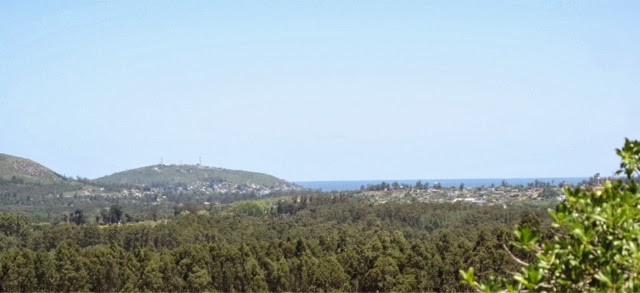
After arriving at a crossroads we had four options, hike up to Sugar Loaf Mountain, go back the way we had just come, turn right to where we knew not what or left back to where we had started.  We chose to turn right and hiked up the hill and found that we were at the old granite quarry.  All of the old machinery is laid out on display  and was very interesting.  From this vantage point you could look up to Sugar Loaf Mountain, elevation 435 metres and the third highest point in Uruguay and look down over the zoological facility and beyond to the ocean.  On top of Sugar Loaf Mountain stands a 35 metre high wooden cross, which can be seen for miles.  We walked back down the hill and watched many iguanas scurrying about their business and made our way back past a few more enclosures to the exit, where we saw this ring tailed Coatimundi in the picnic area.  We were sad to leave.  It was an unsuspected, amazing experience but by now our stomachs were beginning to tell us that we were long past lunch even for South American standards so we drove into Piriapolis and had a sandwich and a cool drink.  Needless to say by which time we were too late to visit the museum...............


Castillo de Piria


Restored Section of Castillo de Piria


Restoration in progress


Inside Castillo de Piria


Inside Castill de Piria


Grounds at Castillo de Piria


Grounds at Castillo de Piria


Grounds at Castillo de Piria


                                                        Grounds at Castillo de Piria


Grounds at Castillo de Piria


Sugar Loaf Mountain


Cockspur Coral Tree Blossoms


Eagle Owl


Ocelot


The Cheeky Armadillos


Male Jaguar


I'm sulking she made me move from my comfortable spot


Collared Peccary


Maguiri's Stork


Fox with an injured front foot


Highly Endangerd Pampas Deer - The are so tiny


Cappybara


Quarry Machinery


Quarry Machinery


View from the hill down over the zoo


View from the hill out to the ocean


Ring Tailed Coatimundi


Looking back from our beach to Casa Pueblo


Barbara on the beach across from Solanas Resort


It looks a bit crowded today????????


Jim on the beach across from Solanas Resort