Wednesday, 19 March 2014

Lima, Peru

Lima, Peru

We arrived in Lima on Thursday February 13th, 2014 and we were collected at the airport by the hotel's driver.  We were staying at the Peru Star Hotel in the pleasant district of San Isidro, which is outside of the old city, in a quieter part of town.  We pulled up in a residential street outside a large pair of garage doors, which unbelievably opened to a nice courtyard, reception area and small restaurant.  After checking in we proceeded through to the back arriving at our petite apartment.  Conveniently for us it was located on the ground floor, beside the water feature and beyond were the gardens and swimming pool.

The apartment had a small kitchen, which we only used for making tea, as breakfast was included in our stay.  The breakfast was very good, with fruits, juices, coffee, tea, eggs, cheeses, ham etc.  We really did not need any more to eat until dinner time.

As we had limited time in this capital city, located on the Pacific Ocean, we booked a city tour, where our first stop was the Parque del Amor, the Love Park.  Parque del Amor, located in Miraflores, overlooks the Pacific Ocean and was inaugurated on Valentines Day, February 14th, 1993.  On Valentines Day each year young couples participate in a competition for the Longest Kiss.  Lovers also come to enjoy the sunsets.  It is part of the Malecon where you can walk, ride bikes, run, etc.  It also has beautiful gardens and a lovely mosaic wall.  After leaving the park we made a brief stop at the adobe and clay ruins of Huaca Pucllana which served as a centre for ceremonial and administration for the advancement of the Lima culture between 200 and 700 AD and is also located in the Miraflores district.  These ruins are still being excavated and reconstructed brick by brick.  From here we went to the historical district passing through Plaza San Martin and stopping for a short while in Plaza de Armas where all of the government buildings, palaces and the cathedral are located.  Our last stop was the beautiful Basilica of San Francisco, but unfortunately photos are not allowed inside.  Lima's first cemetery, were the catacombs under this monastery.  The catacombs were in use until 1808 when a new cemetery was founded outside Lima.  The catacombs were only discovered in 1943 and there are an estimated 70,000 corpses here.  The bones are lined up in narrow hallways with one area of several large holes in which the bones and skulls are arranged on top of each other in a circular pattern.  Apparently, the catacombs ceased to be used, as water seepage over the decaying bodies polluted the city water.  People were buried here so that they were closer to heaven after they were interred. 

The next day we visited Miraflores, the upscale district of Lima, with lovely parks.  There are many feral cats in the parks, who are fed daily by a group of volunteers.  The cats are very well cared for and friendly.  Small children pick them up and carry them around and they just hang like limp rag dolls, seemingly enjoying the attention. Also in Miraflores is the new open air, upscale shopping mall, Larcomar, built right into the cliffs.  It is a popular destination for both international visitors and local people alike, where you can enjoy cinemas, upscale shops, restaurants and beautiful views and sunsets over the Pacific Ocean.  Miraflores also has an amazing artisanal market, located in arcades under cover and known as the Indian Market, situated at Petit Thouars street.  There are many good quality products for sale, bargaining is expected, it is safe and very colourful.  Good Alpaca sweaters are available here.  Miraflores is a very vibrant area with good, hotels, coffee shops and restaurants,

The next day we left for Cusco, Peru and another very different adventure.............


The Love Park


The Kiss - Sculpture in the Love park


Mosaic Wall in the Love Park


Surfers below The Love Park


Huaca Pullana


Italian Art Museum


Bronze Llamas


Plaza San Martin


Plaza San Martin


Plaza de Armas


The Archbishop's Palace


The Famous Hotel Bolivar


The Cathedral


The Bronze Fountain in Plaza de Armas


The Cathedral


Jim crossing the road in Plaza de Armas


Colourful Costumes


Even the dog joined in


Many small town parades take place in Plaza de Armas


Changing of the Guard


Basilica & Convent of San Francisco


Palace of Justice - The Courthouse


Sunday, 16 March 2014

Tiwanaku, Bolivia


Tiwanaku, Bolivia

Bright and early again Enrique and Jorge arrived at El Consulado to take us on our next adventure, Tiwanaku.

Tiwanaku are pre-Inca ruins still being excavated but with little happening at present, due to lack of funding.  When these people left here, for reasons not known, they travelled to Peru establishing themselves in Cusco.

Once again we traveled through El Alto without stopping and once through we were on our way to Tiwanaku.

Among the Pre-Columbus villages, the millennial Tiwanaku site is situated at 3,870 metres above sea level, seemingly in the middle of nowhere and without doubt the culture that has plenty of secrets regarding its origin and mysterious final.  It is recognised by Andean scholars as  one of the most important civilisations prior to the Incas.  It is located between the south eastern shores of Lake Titicaca and the dry highlands which provided fish, plants and good herding grounds for their Llamas.  

First we went to the museums, where no photos were allowed and then to the archaeological site.  The belief of these people was duality.  Everything had to balance.  The sun and moon, air and water, the sky and the earth and so forth.

Just as we left the archaeological site and drove to the restaurant for lunch it started  thundering and lightening.  Once inside under cover the rain came down in torrents. We ate a delicious indigenous lunch with Barbara partaking in Llama and Jim the lake fish.  Both were delicious and after we had finished we were very full.  The restaurant was unconventional for us.  When we arrived our driver went to help in the kitchen, he cleared tables and served our food.  It was all very laid back, friendly and a fun atmosphere.  After we had finished we pitched in and cleared the table.

Just as we were driving away we noticed a new van adorned in flowers and learned from Jorge, who had been speaking with the owners, that they lived in Argentina and had bought this new vehicle.  They had driven 8,400 kilometres to Copacabana to have it blessed and then had to drive the same distance back.  Note the little reed boats resting on the dashboard..............


Looking toward the Andes from Tiwanaku


Tiwanaku as spelt by the indigenous people in the area


The three Bolivian flags.  The one to the left being that of the indigenous people, the one on the right the official Bolivian flag and the one in the middle is to be the new Bolivian flag combining the two flags.


The layout of the Tiwanaku site


Looking through the site toward the Andes


Wild flowers


A view from the site


Looking down on part of the site


Bolivian Thistle


Steps of the Kalasasaya Temple


Heads in the wall Kalasasaya Temple


This head looked like a cat


Another head in the wall!!!!


Pillar in the wall


Gate at the Kalasasaya Temple


The perimeter wall


Another pillar in the wall


Steps into the Temple


The Sun Gate


Detail of the Sun Gate


Back of the Sun Gate


Our lunch Venue


Enrique, Jorge & Jim after lunch


The Blessed vehicle


Friday, 14 March 2014

Lake Titicaca, Tiquina and Copacabana

Lake Titicaca, Tiquina, Copacabana and Isla del Sol

Our guide Enrique and driver Jorge (Henry & George) arrived very early for our trip on Tuesday, February 11, 2014.  We drove through Le Paz and out towards the airport.  At the airport we were back at 4,060 metres above sea level and in the adjacent new city of El Alto.  El Alto is a sprawling city of 1.1 million people with little infrastructure, street dogs everywhere, unpaved main streets, unfinished buildings and basic squalor.  It is a very dangerous place and very dirty.  Hence we drove straight through without stopping.  The people that live here arrived from the countryside in the last decade or so, looking for a better life.  They purchased a small piece of land to build their house on, however, most are unfinished.  Needless to say there is no architectural control!!!!!!!

Leaving El Alto behind we headed out into the countryside with the majestic Andes mountains in the distance.

Our first stop was to a small homestead, where the women were traditional weavers and the men made the reed boats, historically used for fishing on the lake.  It was here also that Thor Heyerdahl, explorer and ethnographer had one of his boats built, the Ra II.  Unfortunately, the fishing boats only lasted for about a year as the reeds broke down in the water, so are now made of wood for greater durability and longevity.  However, the craft is still  being carried on, with the making of model boats for display, patio furniture, etc.

Our next stop was Tiquina, a town which straddles both sides of the narrowest part of the lake where you cross by ferry to travel to Copacabana.  We crossed on the ferry along with the vehicle and several others, on boards that looked somewhat suspect.  We were assured that although they did not look good they were in fact very strong.  They did carry very large vehicles and we did not see one sink so, perhaps it is  true.  On the far shore we drove on towards our first destination stop at Copacabana.  We went straight to the dock and embarked on our little boat that took us to Isla del Sol (Sun Island).  The trip was about forty minutes and when we landed we walked up steep cliffs, visiting Inca ruins on the way to the rustic restaurant, where we partook in a delicious traditional lunch consisting of chicken, fish, rainbow trout which was more like salmon, various varieties of potato, corn and fruit. This was all washed down with the National drink "Coca Cola"  South Americans love their Coca Cola along with similar local brands such as Inca Cola and Quina Cola.  The terraces left by the Incas are now in full use growing all the vegetables consumed on Isla del Sol making them totally self sufficient.  After lunch we took the boat along to the port and climbed the steps of the Incas up the hill, with beautiful views from the top.  On the steps we met a charming little girl who wanted us to visit her llamas and take photos.  We noted she had a small purse hanging from her neck where obviously the payments were duly collected.  We did not have time to see the llamas so she smiled and skipped off.  Also on the steps we passed an elderly lady with a bundle of wares on her back, almost as large as herself.  It was arduous work walking down all those steps and then all the way back up again at night taking the bundle with her.

After our wonderful lunch and visit to the ruins we boarded the boat again for our ride back to Copacabana.  As we were nearing the shore we could see a fierce lightening storm in the distance.  We made it to shore, being met by Jorge, who duly drove us up through the town, to the Basilica.  The clouds by this time had blackened above us in a very angry fashion and just as we reached cover at the Basilica, torrential rain was unleashed.  We headed inside  to the beautiful interior in complete contrast to the very stark exterior.  Unfortunately, no photos were allowed inside.  Luckily, by the time we emerged from the Basilica the storm had passed and we did not get soaked.  We saw the flower stalls outside and the petals outlining the blessing of a vehicle but alas no photo shoot.  

We were at the end of our visit to Lake Titicaca and Copacabana and began our long journey home, but not before stopping briefly to gaze down on Copacabana from above. It is a haven for backpackers, where they say a good room costs as little as seven dollars U.S, per night.  We drove on once again, boarding the ferry at Tiquina, for our final leg of the journey.  We stopped once more for an awesome view of the Andes, yet again in all their glory.  We arrived back very tired, had a quick bite to eat and fell into bed.  The following day was another long trip to the pre-Inca ruins at Tiwanaku................


Traditional Weaving


Traditional Reed Handicrafts


Model Reed Boat - Type used by Thor Heyerdahl


Reed Boat on the lake


Jim on the ferry at Tiquina


Ferry at Tiquina carrying large vehicles


View of Tiquina


Tiquina


Inca Terraces - Tiquina


Copacabana - Bolivia


On the boat going to Isla del Sol


Isla del Sol


Inca Ruins - Isla del Sol


Inca Terraces - Isla del Sol


Inca Terraces and the small port - Isla del Sol


Wild Flowers - Isla del Sol 


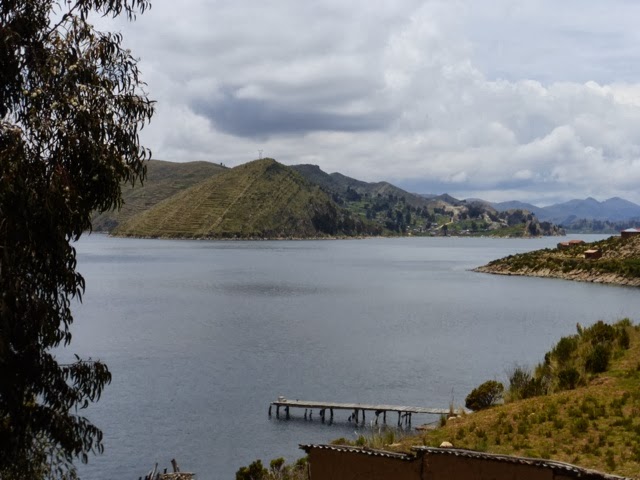
View from Isla del Sol


View from Isla del Sol


Jim and Enrique having lunch with the National Drink - Isla del Sol


The Inca steps - Isla del Sol


The little girl and the old woman on the steps


View from the top of the steps


Inca Terraces on the way back to Copacabana


Cave nearing Copacabana


Storm brewing over Copacabana


Artisan shops - Copacabana


The Basilica - Copacabana


The Basilica - Copacabana


Looking Back from the Basilica across the courtyard - Copacabana


Flower stall outside the Basilica after the downpour


Looking back down over Copacabana from a viewpoint


Last but not least - the Magnificent Andes Mountains